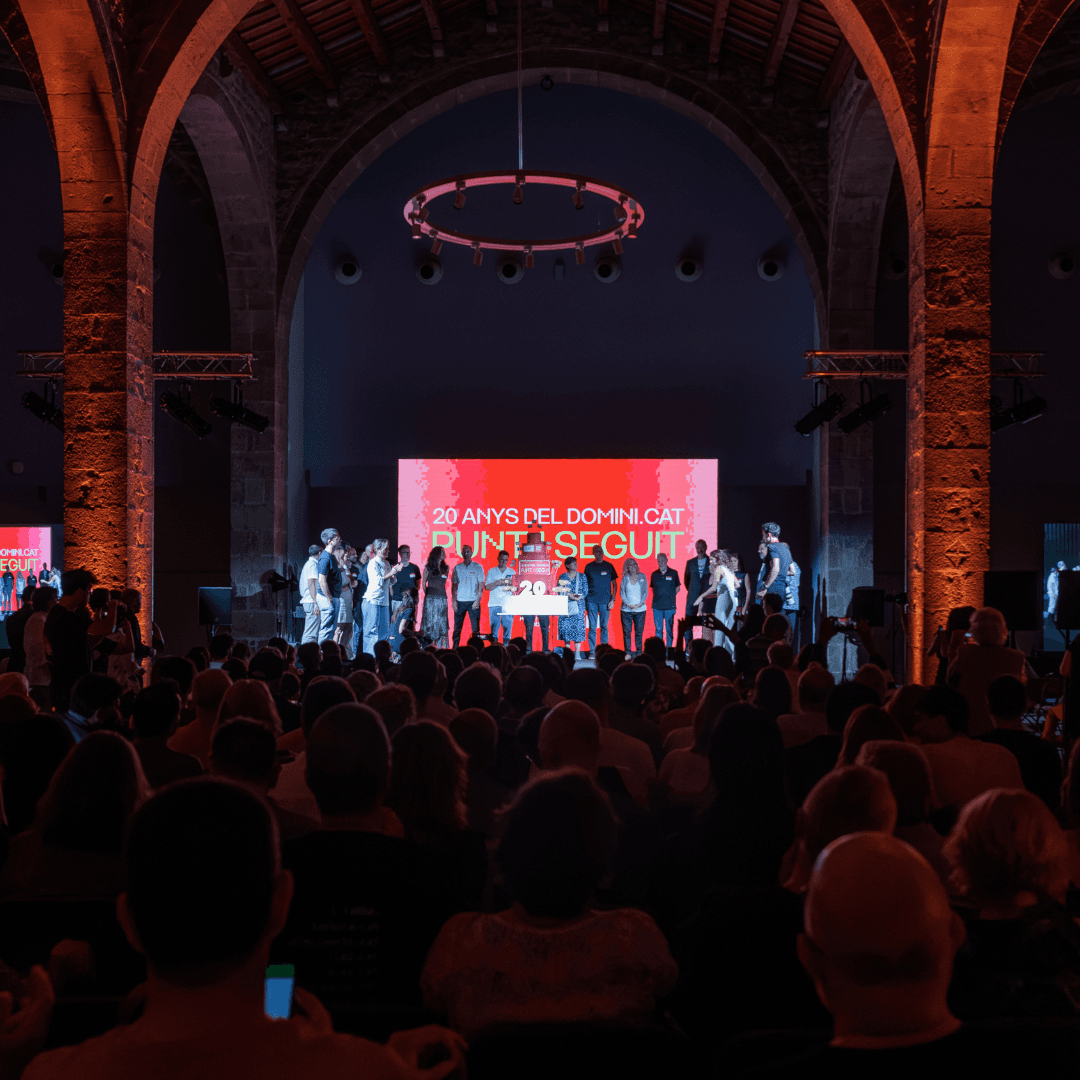


The origins of the .cat domain: the story of an idea that seemed impossible

How .cat was born: its founders retrace the path from the initial idea to ICANN approval, back when hardly anyone thought it was possible.
How do you build a milestone that no one had achieved before? Twenty years after the approval of the .cat domain, some of its main driving forces came together again to reconstruct a story that began long before 2005 and that, for years, seemed impossible.
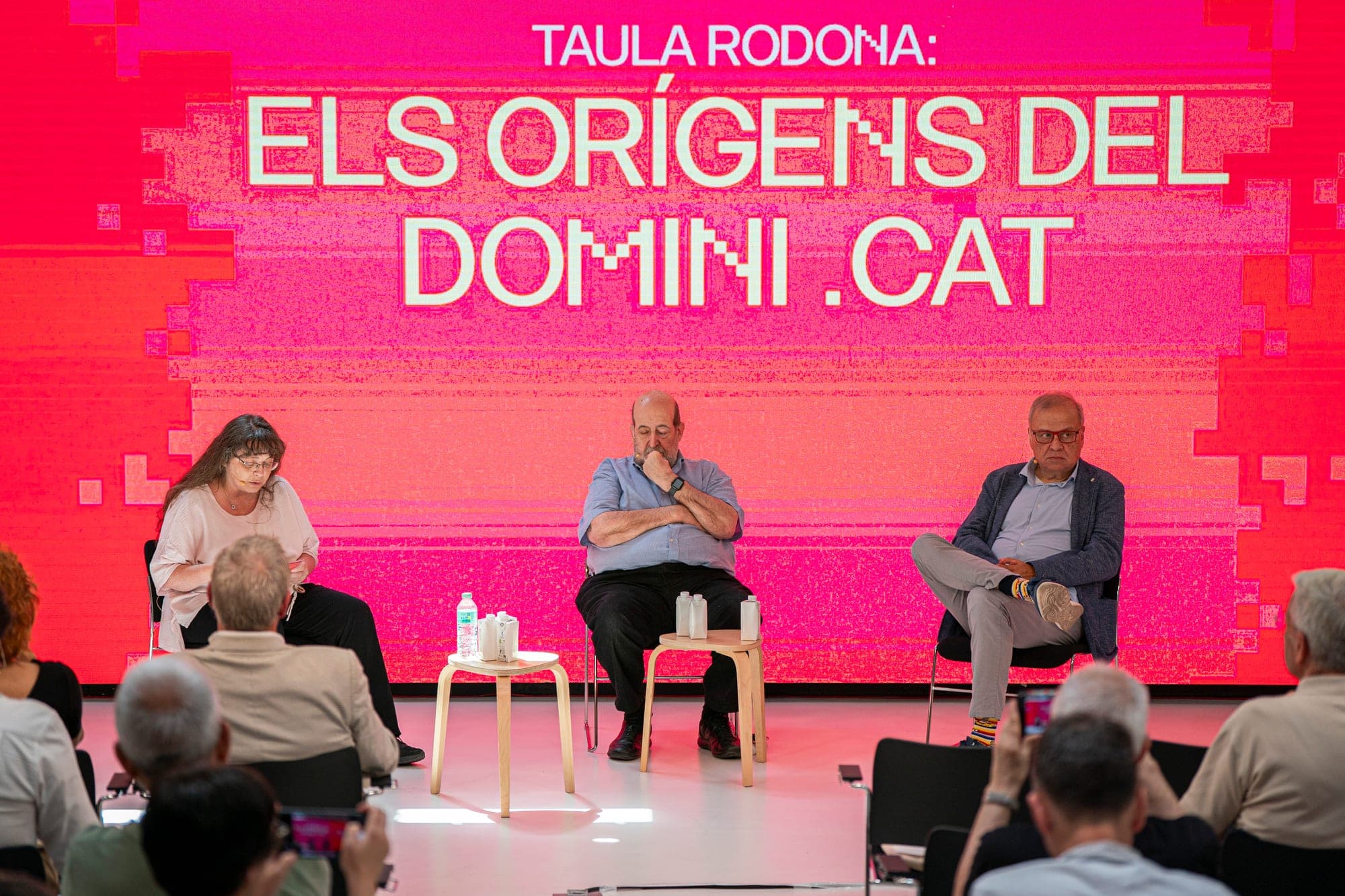
Moderated by journalist Mercè Molist, who followed the whole process of creating .cat closely, the first round table of the 20th-anniversary event brought together Amadeu Abril, driving force behind the .cat application, and Manel Sanromà, former president of the .cat Foundation. Between the three of them they looked back at the key moments of an initiative that ended up becoming the first Internet domain created to represent a linguistic and cultural community.
From a discarded idea to an unexpected opportunity
Mercè Molist recalled that the wish to have a domain of one’s own went back a long way. In the mid-1990s, a group of Internet users had put forward an application for the .ct domain, but two-letter domains are reserved for states and every effort ran up against the same obstacle time and again.
It was in 2003 that Amadeu Abril put forward a completely different alternative: to abandon the idea of a territorial domain and propose a domain to represent a linguistic and cultural community. That shift in perspective turned a demand with no way forward into a viable application.
«The idea of .cat came about because it was fair and necessary.»
Abril explained that the Internet was already, by then, a space where millions of people interacted mainly through language. If there were domains for states or for professional sectors, it also made sense for there to be one for a cultural community. The challenge was to convince ICANN that this community also deserved a space of its own.
Turning a good idea into a real project
If the idea was the first step, turning it into a solid application took years of work.
Manel Sanromà recalled that, when he first learned about the project, it struck him as a great initiative, but he was also aware of how difficult it was. The application had to open doors in arenas where Catalonia had never had a presence and to convince counterparts who had no similar precedent on the table.
The strength of the project, however, did not come only from those driving it. The support of tens of thousands of people, companies and institutions turned the proposal into a collective initiative, capable of showing that behind .cat there was a real community willing to defend it.
When circumstances are also part of the story
During the conversation there was also room to recall that major projects often depend as much on preparation as on context.
Sanromà explained how various political and institutional changes ended up creating a favourable scenario for the application to succeed. Without that earlier work, nothing would have been possible; but without a particular set of circumstances, probably neither would it.
That recollection served to highlight that the approval of .cat was not down to a single factor, but to the coming together of years of preparation, a technically solid application and a political moment that allowed the project to reach a successful conclusion.
Twenty years on, the lessons still hold true
The conversation closed with a look beyond the historical account. Both Amadeu Abril and Manel Sanromà agreed that the main legacy of .cat is not just having secured a domain, but having shown that communities can lead the way when they are able to organise themselves, identify an opportunity and persevere over years.
For those behind the project, the story of .cat is a reminder that great digital transformations do not usually begin with large structures, but with people capable of imagining what does not yet exist and of building the consensus needed to make it a reality.
OTHER POSTS YOU MIGHT BE INTERESTED IN