

The .cat domain, twenty years on: from pioneer to international benchmark

From being the world’s first cultural and linguistic domain to becoming a model other communities look to when claiming their place online.
When ICANN approved the .cat domain in September 2005, the world of the Internet was entering uncharted territory. For the first time, a linguistic and cultural community obtained a domain of its own, opening up a path that, years later, would be followed by other initiatives such as .eus, .gal, .bzh, .scot and .quebec.
Two decades later, that pioneering role continues to shape the trajectory of .cat, but from a different position. It is no longer just a success story that is remembered, but an active voice in the arenas where the future of the Internet is decided.
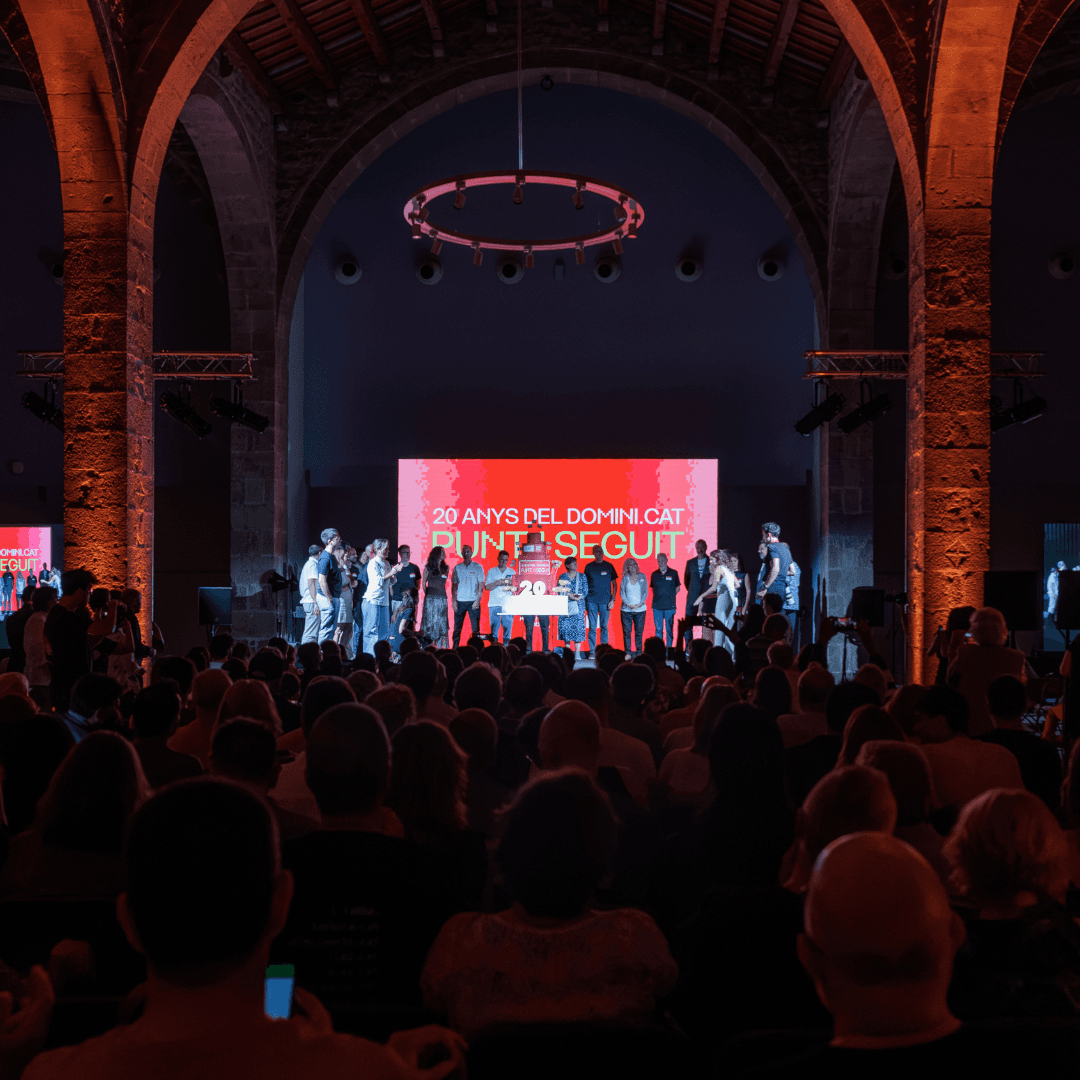
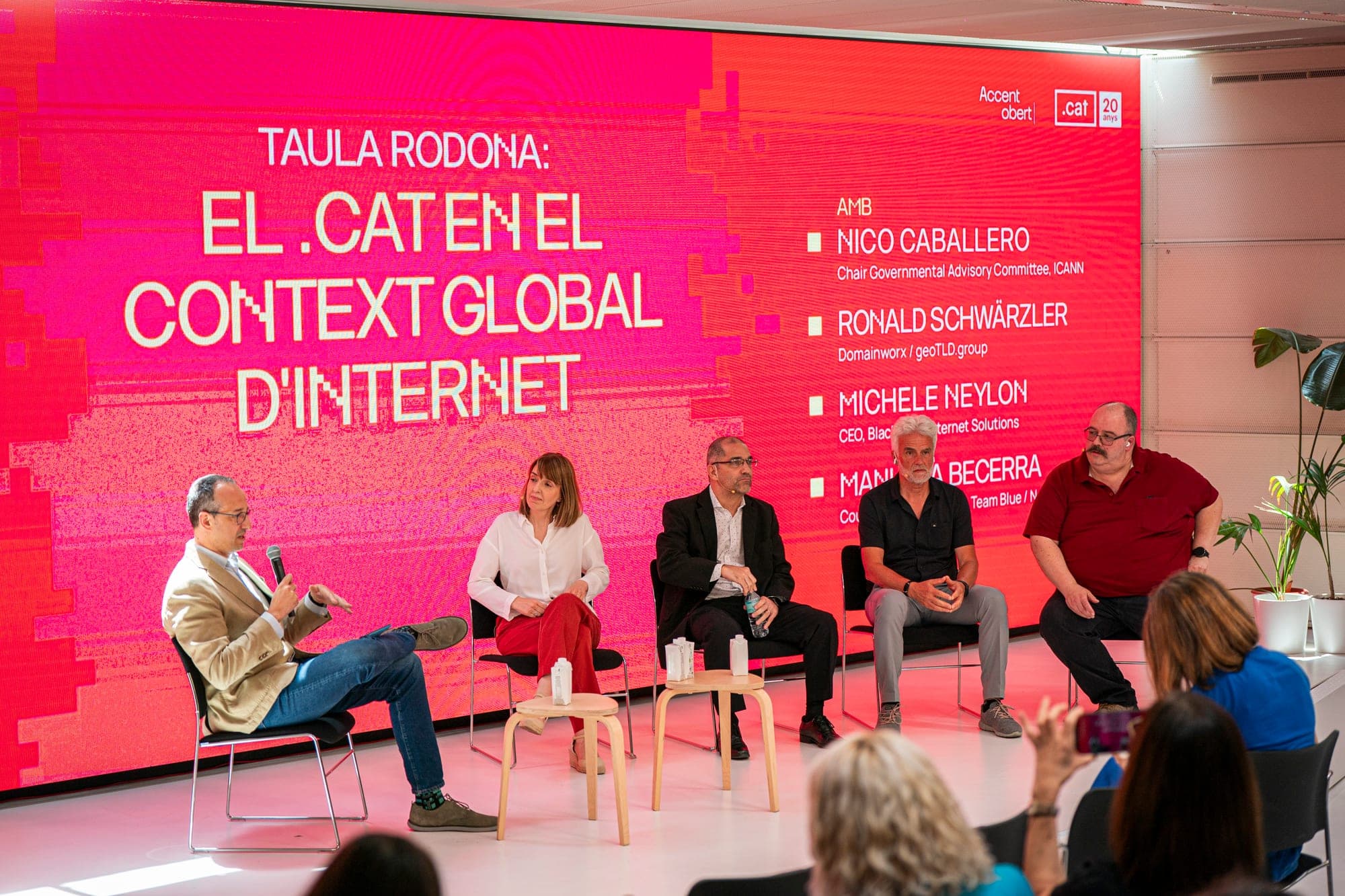
This was the central idea of the third round table of the 20th-anniversary event for the .cat domain, moderated by Nacho Amadoz, Legal Director at Accent Obert, with the participation of Nico Caballero, Chair of the GAC (ICANN Governmental Advisory Committee); Michele Neylon, CEO of the Irish registrar Blacknight; Ronald Schwärzer, driving force behind .wien; and Manuela Becerra, Country Manager at Nominalia / TeamBlue.
Opening up a path that others were able to follow
During the conversation, the participants recalled that .cat not only achieved a milestone for the Catalan-speaking community, but also showed that it was possible to conceive of Internet domains beyond states or economic sectors.
That decision ended up opening the door to a new generation of domains linked to languages, cultures and collective identities.
Ronald Schwärzer particularly recalled the help he received when he was working on the application for the .wien domain. He explained that Amadeu Abril and the .cat team shared their experience in a completely selfless way, an attitude that, he said, has shaped the way the international registry community understands collaboration today.
«They weren’t competitors. They were colleagues. And, in the best sense of the word, friends.»
An international community built on collaboration
One of the ideas that most ran through the conversation was that domain registries do not compete with one another in the way that other technology sectors do.
On the contrary, they share knowledge, experiences and good practices because they all face similar challenges: cybersecurity, the technical evolution of domains, international regulation and the changes brought about by new technologies.
The participants agreed that this culture of cooperation has been one of the sector’s strengths over the past two decades, and they placed .cat among the registries that have done most to consolidate it.
When Barcelona speaks in .cat
Michele Neylon offered a particularly telling perspective from outside Catalonia.
Used to working with registries all over the world, he explained that one of the things that most surprises him every time he visits Barcelona is the visible presence of the .cat domain on the streets.
«When you walk around Barcelona and see so many web addresses ending in .cat, rather than .com or .es, it’s really striking.»
For Neylon, this presence shows that .cat has achieved something very few domains can claim: becoming a recognisable digital identity well beyond its technical function.
The value of closeness
The .cat domain is a close one, not only for the community it represents, but also for the registrars it works with. That is how Manuela Becerra put it; besides speaking of .cat’s excellent relationship with its channel, she also highlighted the domain’s distinctive quality: a closeness that shows in its respect for the language and in the authenticity it brings.
In a world where building websites is increasingly easy and automatic thanks to artificial intelligence, having a .cat is a mark of quality that says a lot about whoever displays it.
Continuing to take part in the decisions that will define the Internet
The conversation also looked to the future.
Nacho Amadoz and Nico Caballero explained the role Accent Obert currently plays within ICANN and other international Internet governance arenas, taking part in working groups, research projects and initiatives supported by the ICANN Grants programmes.
It is work that is largely invisible to the general public, but essential to keep the needs of linguistic and cultural domains present in the debates about the future of the Internet.
The participants agreed that these arenas will become increasingly relevant in a context of accelerated transformation, shaped by artificial intelligence, new search models and the evolution of digital infrastructure.
From precedent to commitment
When .cat was born, its main challenge was to show that a linguistic community could have a domain of its own.
Twenty years on, that debate is already part of the history of the Internet. The challenge now is a different one: to keep taking part in building the future of the network so that languages and cultures continue to have a voice in an increasingly global digital ecosystem.
The panel left one idea clear: .cat remains a project deeply rooted in its community, but its impact long ago went beyond the boundaries of the domain. Today it is also part of the international conversation about what the Internet should be like in the coming decades.
OTHER POSTS YOU MIGHT BE INTERESTED IN