

.cat is your home

On an increasingly automated and opaque Internet, domains matter again: they are the identifiable space from which to speak and to which you can always return.
For some years now, domains seemed to be little more than a relic of the Internet. A foundational technology, useful and necessary, but less appealing than the new layers that have moved to the centre of our digital lives: search engines, messaging, social networks, apps, platforms or, more recently, the revolutionary and inevitable artificial intelligences.
It is understandable. Our attention tends to go where the newest and most stimulating things are happening. For quite some time, some have wanted us to believe that the future of the Internet would be built mainly on platforms controlled by a handful of people with shared interests that did not necessarily coincide with the common interest. Digital landlords, if you will allow the metaphor. Apparently free spaces that allowed us to publish, connect, sell, explain ourselves or build audiences. A future in which having your own website or your own digital infrastructure seemed unnecessary.
But major moments of change force us to reconsider the value of what we had taken for granted. In an increasingly automated, mediated, opaque and algorithmic universe, a basic need reappears: knowing where we are. Knowing who is behind what we read, whether a source is reliable, what context explains the content and what bond it has with the community it addresses. Knowing, ultimately, who is responsible for what.
The more uncertain the digital environment becomes, the more valuable the infrastructures that give us certainty
In this new scenario, domains gain value. Not because they are new, but because they provide continuity amid the unpredictability of change. Not because they solve everything, but because they offer the most elementary certainty of the digital world: an identifiable space from which to speak and to which one can always return. Your home.
A domain is not just an Internet ending. It never has been. It is a way of saying: this is my place. This is my name. This is my commitment. This is my community. Choosing a domain may once have seemed an almost irrelevant decision. More than two decades later, we know that it is a statement with profound consequences.
.cat was born from that intuition. When the Catalan-speaking community promoted a domain of its own, it was not simply asking for a technical label for a set of websites with common features. It was affirming that a language, a culture and a community had to be able to have their own place on the Internet. That the human diversity of the physical world also had to be reflected in the digital universe. .cat was not meant to be a subordinate presence, but a place of its own, recognisable and built from within the community itself.
From an Internet of pages to an Internet of systems
The first years of .cat belong to an Internet of websites, hyperlinks, search engines and relatively visible identities. People, companies, organisations and institutions built a digital presence and trusted that audiences would reach it through a search, a recommendation or by remembering an address. The Internet was already immense and complex, but it still preserved a certain traceability: someone searched, found, entered a page and recognised its source.
Twenty years later, that sense of control has weakened. Web pages have not disappeared, but they are no longer the only gateway to the digital world. Increasingly, information will reach us already processed, summarised or reinterpreted by automated systems that will have travelled part of the way before we do. Digital assistants will answer questions. Artificial intelligences will synthesise sources and turn scattered content into apparently reliable answers. But they will not always be reliable.
This change also modifies how relevance is built. If the main challenge before was having a space of one’s own, in an Internet mediated by models, recommendation systems and assistants, the challenge is no longer simply to be there, but to be recognised and interpreted in the right context. Not to be diluted within systems that process the world at scale. And this is true for Catalan speakers and for almost any culture.
Context will be the new infrastructure
If the first years of the Internet were defined by presence, the next ones will be defined by context. It will not be enough for a language to be present in a database, for fragments of a culture to appear in the results of an artificial intelligence, or for a community to participate in platforms disconnected from one another. That activity will need to be related, contextualised and understood as part of a single whole.
It will not be enough for machines to find (and return) words in our language. They will have to recognise entire worlds. And these cultural ecosystems will not be built only with isolated content in the hands of third parties, but with infrastructures of our own, recognised sources, civic institutions and community bonds that provide trust, certainty and continuity.
This has always been the function of domains, and of .cat in particular. A domain does not, by itself, guarantee the quality of a piece of content, but it helps establish its origin. It does not replace authorship, but it identifies the community to which it belongs. A domain is your home because only there can you display ownership, permanence and responsibility for what you say and for the context in which it should be interpreted.
This original function is now more valuable than ever. A domain allows us to recognise where a voice comes from and what framework it relates to, to build our own digital heritage and to avoid depending entirely on the visibility granted to us by platforms with changing interests, priorities and rules.
Taking part without being diluted
Let no one misunderstand. This is not an argument against platforms or against artificial intelligence. A living community is not defined by its ability to isolate itself, resist change or resign itself to it, but by its ability to anticipate it and intervene in it. And Catalan speakers know a great deal about that.
Now, as before, we will not remain on the margins of the new Internet. We can put our experience at the service of all non-hegemonic cultures that are also asking themselves how to have their own space in an increasingly concentrated digital world. Because .cat has a value that goes beyond its own community.
For too long, some cultures have been tempted to explain themselves in terms of exception, resistance or fragility. But twenty years of .cat allow us to tell a different story: that of a community that understood early enough that the Internet would not only be a channel of communication, but a space where identity, relevance and future would be built. That of a language that did not wait for someone to grant it a place, but organised itself to have one. That of a culture that showed that digital diversity also needs infrastructure.
In 2026, to defend the domain, strengthen it and project it into the future is to defend a model of the Internet in which cultural communities can be recognised without depending solely on dominant political, economic or technological frameworks. An Internet where cultural diversity is not just a superficial layer, but also part of its deep architecture. An Internet where having a voice does not depend only on the size of the market, the strength of a platform or the centrality of a global language.
An experience of our own with a universal vocation
Catalan speakers are not starting from scratch. Twenty years ago, we arrived early at a conversation that later became global: how can communities have their own place in the digital world? Today that question returns with greater force and urgency, but in new forms. The Internet is no longer just a space through which information circulates. It is where the way we understand the world is selected, processed, ordered, represented and conditioned.
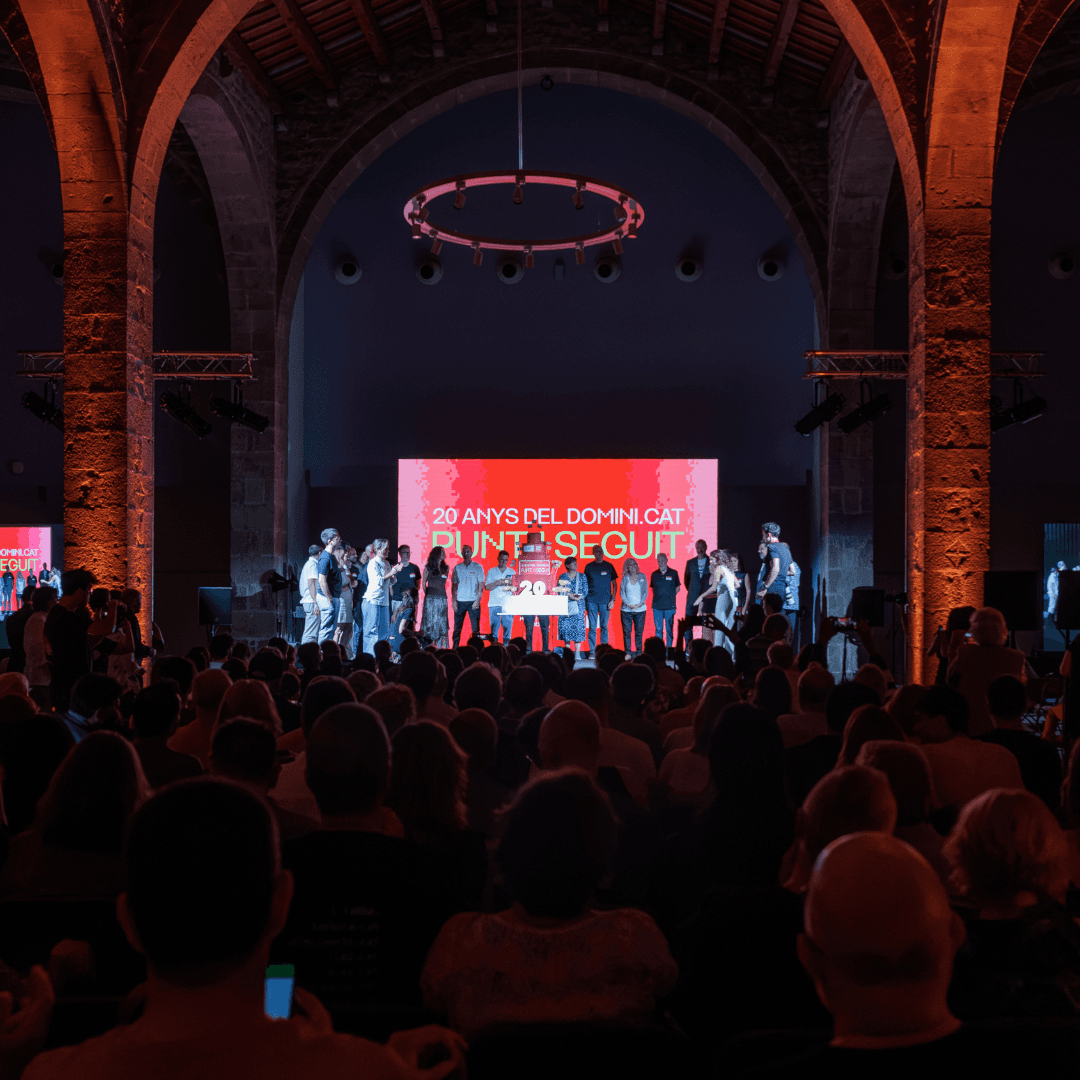
That is why the twentieth anniversary of .cat cannot be only a milestone we commemorate with nostalgia. It is right to celebrate the path travelled and to recognise those who came before us. But what matters most will not be found by looking back, but by understanding that we are once again facing a moment with something foundational about it. The technologies, the actors and the forms of mediation have changed. But our need to have our own space there, our own home, has not changed.
Domains, and .cat very especially, are not a relic of the first Internet. They are one of the fundamental tools we will need to build the next Internet and make it more habitable. And it has already begun.
OTHER POSTS YOU MIGHT BE INTERESTED IN